

Apparently a village near Shenzhen, China called Dafen is responsible for 60% of the world’s reproduction oil printings. They operate by reproducing famous paintings at the request of clients, much like a factory, except that instead of factories the production is still done by hand.
REGIONAL collaborated with some of these artists to paint a picture of themselves, using the same technique and styles of the masters they reproduced:
REGIONAL productively collaborated with the otherwise commoditized community in Dafen by asking selected individuals, some for the first time, to imagine themselves in their professional medium. The final works show the technical, creative, and professional facets of the artists identities subsumed by the styles and relationships they maintain with specific famous artists. The hybrid result of original subject with derivative style comments on originality, global cultural production and REGIONAL’s cooperation with emerging enterprise forms that are internationalizing the village.
The product of the collaboration are sets of images (seen below) comprising a digital photo of the artist in his studio, an indicative painting of their usual output and an original self-portrait. While the final works contain both the creative signature of the original masters and the emergent self-consciousness of the Dafen artists, it is equally important to note that they derived great fulfillment from using their talents freely, and were remunerated at a rate commensurate with the unique international nature of the project.
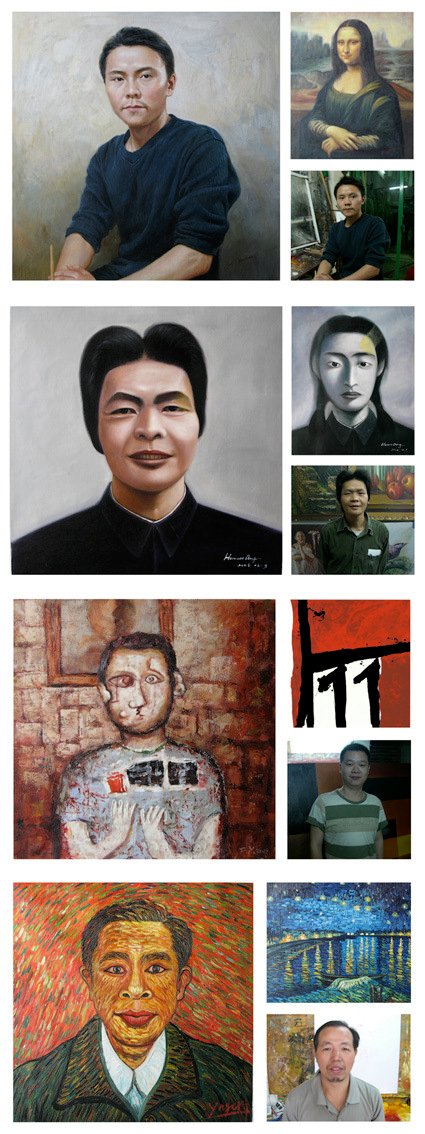
If you think of a reproduction factory, perhaps the analogy that comes to mind is a photocopying machine. Painting in (original), painting out. But as these self-portrait clearly shows, there is an important but subtle difference. The artists mastered the technique to paint in a particular style, with as much skill level (painting technique wise) as Mr. Van Gogh, Renoir or Da Vinci. And it is this that gives them the ability to paint other (original) paintings such as these self portraits.
Which makes me wonder – what if these obviously talented/skilled artist came to to venture on their own? Would they be unable to paint anything that isn’t the exact derivative of the master-style that they’ve adopted? Would it probably be a question of social-connection rather than technical mastery that hinders them from being recognized as an artist in their own right?
[REGIONAL blog with several more examples]


