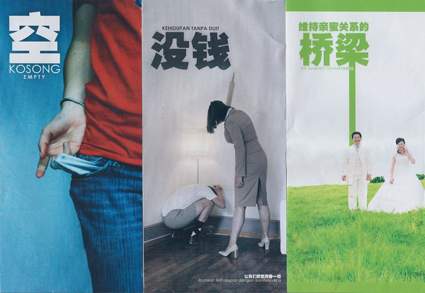
Pulp fiction is a niche comic targeted at marketing and perhaps more specifically, graphic branding people. Above are just some excerpts taken out of one of the issues “Logo Reflections” where the artist pondered what would it be like if logos were more a current reflection of the company rather than the (future) projections. Each issue is about 20+ ’slides’, and there are already ten issues!
While we may be quite familiar with the Photoshop interface on our screen, the artist here has taken to recreating it painstakingly in real life, even including the layers and menus. Pretty cool huh?
I saved this picture but I forgot to keep the source - anyone knows who to give credit to?
Perhaps I should count myself deprived, or maybe just too young or something - when the NYTimes reported on artist Chris Burden constructing a 65-foot tower using stainless steel modular pieces, I was in awe. I’ve never seen or heard about these metal trusses before - and thought ‘Wow, these are like LEGO for grown-up engineers or something”.
It’s inspiring to see these basic building blocks stretched right to its limits:
“The fact that it is both a model and the height of a real building is bizarre,” she said. “It is simultaneously right and wrong from a traditional building perspective. And so it starts to play tricks on you.”
The pieces he used were stainless steel replicas of a toy commonly known as ‘Erector Set’s, which to my surprise was launched almost a hundred years ago back in 1913, and created history by being the very first toy to be advertised nationally.
Wish we’d see more (resurgence) of toys like these. Open-ended, as-challenging-as-your-imagination, and probably encourages kids (and adults!) to take interest, understand and marvel at engineering and construction ideas.
As the world becomes more connected through the tubes of the Internet, we’re certainly also seeing more and more graduation shows moved outline (or at least, duplicated somewhat) so that the results of the students toil can be shared across the world.
Here are some of the works from Central St. Martins, hosted on Flickr here; meanwhile I’ve picked up some that I thought were interesting:
Slow Down Fast Food - by Pearl Chung
Slow Down Fast Food explores how different food containers can pare down the original ‘fast’ intent of the fast food into a more gradual, spread-out ritual of food consumption:
In Slow Food culture, apart from the quality of food, it is important that whether people really enjoy what they are eating and whether they can find the pleasure from it. Therefore, if people really enjoy the process of food consumption, no matter what kind of food it is, all kinds of food can actually be Slow Food. I initiated a task to design a set of products to encourage people enjoy their Fast Food consumption and to have more sitting down occassion with the others while eating Fast Food.
Please Keep my Secrets - by Mayuko Sakisaka
Meanwhile, Please Keep my Secrets explores the evolution of communication between significant halves, and steps up to restore a bit of nostalgia and tangibility in the SMS-era:
Letters offer a more poetic and romantic medium than emails or texts. I feel that this is the vanishing quality of the communication in the digital age. I initiated a task to design an electric devise to transfer the potential of this older communication tool to the text message. Fundamental concept is to see how a mobile message from a boyfriend can be kept in physical object in more emotional way.
The Cult of Design - by Lee Yunn Si
This is a much more whimsical and playful approach to the whole thing about design superstars - they’re so super, the very image of them are now design collectibles:
Where consumption is the new religion, this project explores the growing worship of Design and seeks to stimulate discussion of this contemporary phenomenon. So, if you find yourself coveting these limited edition designer toys, ask yourself why.
With The Incredible Hulk just around the corner, I suppose Mr. Green Giant would be more busy with promotions and screening galas. But what does he do on the rest of the years? Well, it turns out that he’s putting his talents to work loading/unloading greengrocer trucks:
Here are some of his fellow superhero buddies putting their talents to good use when they’re off-screen:
On a more serious note, these photographs are actually a series by Dulce Pinzón, a Brooklyn-based photographer. Through this series of photographs, she examines the roles of Mexican immigrants in the role of the American economy:
The principal objective of this series is to pay homage to these brave and determined men and women that somehow manage, without the help of any supernatural power, to withstand extreme conditions of labor in order to help their families and communities survive and prosper.
This project consists of 20 color photographs of Mexican immigrants dressed in the costumes of popular American and Mexican superheroes. Each photo pictures the worker/superhero in their work environment, and is accompanied by a short text including the worker’s name, their hometown in Mexico, the number of years they have been working in New York, and the amount of money they send to Mexico each week.
The silent contributions of the Mexican immigrants are highlighted through the instant recognition derived from the superhero images that are well-anchored in our pop culture. In this way, we recognize that these immigrants do contribute heroic efforts within the economy, but with much less fan-fare, adoration and dare I say respect.
Joe, a talented (graphic artist perhaps?) guy started a a year-long project over at Toy-A-Day recently, where he’d design, construct and post a new paper toy from a basic template each day for one year.
Here are the collections from Day 1 to Day 18 - pretty cool huh? What’s more, some of them are available as down loadable PDFs for your own amusement and handicraft session. With their flat bottoms, they’re perfect for perching on top of your monitor to lift a spirit or two!
It almost looks like just another video of cute birds and nature - though this one has an interesting moment towards the end of the video. Without giving too much away, I’d say the bird looked a whole lot cuter - and almost like something coming out of a computer game.
Alright, if you’re that impatient, push the bar to the 2:10 mark.
[Edit]
Added another video below at Linyou’s recommendation - another bird called the Lyre Bird with amazing talents in imitating sounds: from bird chirps to decidedly more…man-made sounds like machines and sirens. The first case of music piracy in bird-land:
BMW has just unveiled their latest concept called GINA Light Visionary - GINA being an acronym for their design philosophy behind: Geometry and Functions In ‘N’ Adaptations (I suppose GINA sounds cooler than GIFNA?). At my first glance, I thought it was not too radical - the initial impression was a concept that was probably a sportier extension of the Mille Miglia concept unveiled back in 2006.
But after going through the video (in Youtube above), I realized it was a rather radical and refreshing perspective of automotive design - this may yet be a watershed in automotive styling. BMW has always been experts in dealing with expressive surfaces (that are often sharply ‘clipped’), with one of their master strokes being the iconic negative curvature found along the sides of many of its sportier cars. But I think in GINA they re-thought the whole tradition of car body designs.
In typical automotive designs, you have a certain structure on which you add metallic panels on. You can style these panels in as many ways as there are cars on market now - but they are generally all seen as panels. The associated possible actions are linked to traditional metal sheet forming technologies - bending, rolling, cutting, etc., as the automotive designers think of themselves as sculptors, adding or coring away extra ‘clay’.
In GINA, instead of hard panels, the body is conceived more like a soft skin wrapping against a skeleton body. While it may very well be made of metal panels eventually just like any other cars, the important thing is at the design level, the ’skin’ metaphor brings out a whole set of different analogies and thus designs - you’re thinking about creases, pinching, pricking, etc. Design is thus by growing and subtracting the inner skeleton (which then defines the creases). I particularly liked the quote by Chris Bangle in the video: “…let’s let material talk in a different manner; and let the tooling be a different issue, instead of just a way to give us form.“
There are some other interesting features enabled by such a skin too: for example, there can be a continuous line on the sides, with the door creasing and folding away rather than opening/lifting. It could also consume less resources to build and drive, since the fabric would probably be lighter and require less manufacturing energy. Imagine also the possibility of changing the profile of your car exterior at a whim - in a fabric concept, it may be as simple as pressing a knob to rotate or shift the underlying skeleton.
It reminds me of Gehry’s Guggenheim too - which was for architecture another conceptual breakthrough: where technology has grown to such sophistication that we can in fact produce a building not by ‘ground-up’, ‘level-by-level’ structure which is then clad by facade. Instead, the building was defined much by its skin itself, its transformations and its refreshing organic lines.
In a way, I also felt it made the car more organic - it’s almost like a silent…monster. As it lifts it eyelid, the head lamps project its vision menacingly ahead; the unveiling of the bonnet reminds me of open-heart surgery; makes me think about Toyota’s ‘Human Touch’ ad too (haha both are somewhat creepy).
Overall, I must say this is one of the most refreshing and innovative concept cars that I’ve come across these years. There are many concept cars that are wild, interesting, etc. but I thought the GINA managed to tackle car design in a whole new perspective, while inheriting the qualities that make it a BMW.
Bravo to the design team!
(And if you’re the essay type, here’s their philosophy (wall-of-text!))
As what’s stated in the picture, it’s quite easy to underestimate the size of Africa. Personally I’m rather surprised to see how many large countries Africa can comfortably hold -
It shows how Africa (30,3 million km²) is larger than the combination of China (9,6 million km²), the US (9,4 million km²), Western Europe (4,9 million km²), India (3,2 million km²) and Argentina (2,8 million km²), three Scandinavian countries and the British Isles (map gives no surface for these last two areas; I’ve rounded out the figures for the aforementioned regions).