India-Pakistan Border Closing
The border-closing ceremony at Wagah (between India and Pakistan) has probably been around for quite a while, though it’s only recently that I’ve came upon this interesting video documenting the daily ritual of shutting the borders. Peacocking around with much fanfare and exaggerated stomping and marching, guards from both sides engage in what is probably the world’s most entertaining (bizarre?) ritual in border-administration.
From Wikipedia:
The Wagah border often called the “Berlin wall of Asia”, is a ceremonial border on India–Pakistan Border, where each evening, there is a retreat ceremony called ‘lowering of the flags’. At that time there is a very energetic and thrilling parade by the Border Security Force (B.S.F), India and the Pakistan Rangerssoldiers. It may appear slightly aggressive and even hostile to foreigners, but it really is just spectacular entertainment for the crowds with grandstands having been built on both sides. Troops of each country put on quite an entertaining show in their uniforms with their colorful turbans. Border officials from the two countries sometimes walk over to the offices on the other side for day to day affairs. The happenings at this border post have been a barometer of the India-Pakistan relations over the years.
Certainly more than your average passport stamping!
Pigeon: Impossible
Pigeon:Impossible is a short animation with a rather quirky story premise:
A rookie secret agent is faced with a problem seldom covered in basic training: what to do when a curious pigeon gets trapped inside your multi-million dollar, government-issued nuclear briefcase.
To me, what is much more interesting though is the series of video podcasts by the creator Lucas Martell on the Youtube page, explaining different aspects of how the animation came into being, tips/techniques on 3D video rendering, etc. Examples like:
Hacking the glint on the eye with a clever workaround:
Behind-the-scenes on the Pigeon’s construction:
You can also visit his blog with even more back stories to 3D animation.
Kaide Taide
It’s always great to see something wonderfully human arising out of (almost) nothing through astute observation and simple designs. Kaide Taide (by Finnish designers-duo Aamu Song and Johan Olin) transforms the spaces around the stairs and lobbies – most typically just dead spaces with little lingering value – into spaces for interaction (both with other humans or with the railing itself), whether for a quick rest, a hearty chat or a glancing peep down the stairwell.
Right now it exist simply as an art installation in Helsinki, but I’d say there’s plenty of opportunity for this to be brought to the public, particularly urban cities like Singapore where the large majority of its people live in flats that may have similar spaces.You can also see many more sketches and other types of manifestation over here.
[via designboom]
Green Screen in Movies
We know that ‘green screens’ (or more accurately, “Chroma Key“) are commonly used in filming, be it weather or action movies so that the actor/presenter need not be physically within the context of a scene, whether for safety, costs or technical reasons. The reel from green screen specialist studio Stargate would show just how much it is used in movies and dramas:
Actors probably have gotten better over the years, as they adapt to this technique during acting to respond to non-existent cues within the movie frame. For instance, the instinctive slight shivering while walking through a particularly cold street in Russia – without the immersive visual and visceral setting, one has to imagine the hundreds of minor environmental cues that may affect a character within the environment’s context. Tough!
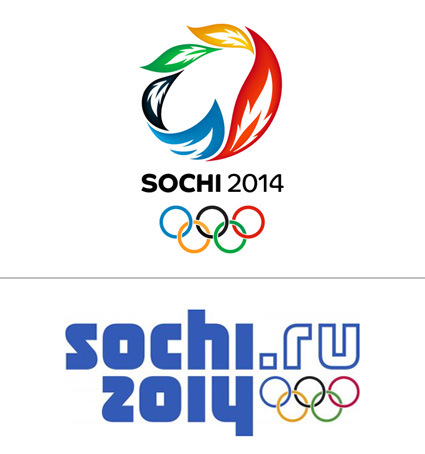
Sochi 2014 Olympics Logo
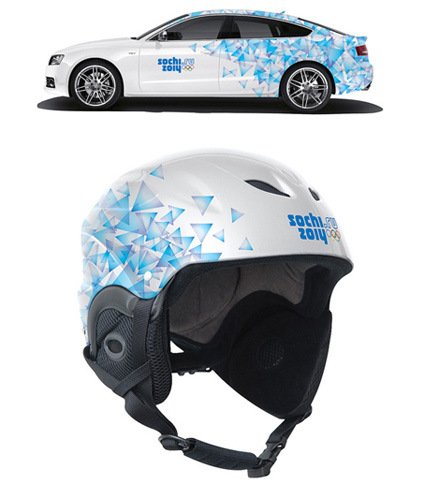
Even as the Vancouver Winter Olympics draw nearer at 2010, Sochi (the Russian host city for the next Winter Olympics in 2014) has already rolled out their brand identity. Now, if you were in charge of the Sochi Olympics, which would you choose? My first reaction was certainly the top one – it looks fresh, Olympic-esque and contemporary. The one at the bottom had so much Russian old-schoolness, it seemed like they were still stuck in the Soviet-Russia era, and have not caught on the graphic design evolution.
But following the argument on Sans Raison made me a convert (it’s too detailed to be quoted or reproduced her – please head over!) – as she carefully and patiently compared between the 2 final candidates, and espousing the merits of this logo that has much more long-term strength in its identity; that Olympics logo frequently falls into a certain cliche (like the one at the top). Eventually I became a convert for the second one too.
Of course, seeing it being applied in context gives it a whole new render/perspective as well:
In context, it does hold a lot on its own (although the shade of blue on the logo in context seem much friendlier too). You can also check out the full identity in action at their official website.
[inspired by Sans Raison]
Radiographs of Trauma
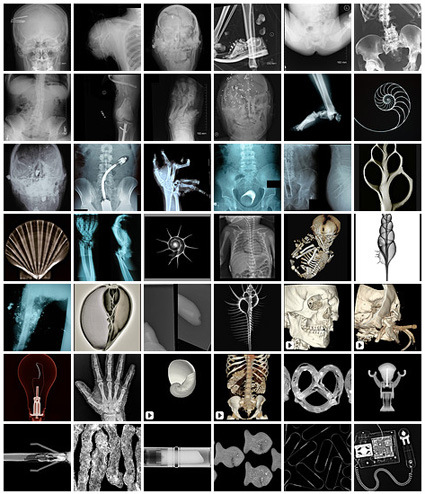
While the incidents leading to each of the picture in the above set is probably a traumatizing one, there is still very much inherent (artistic?) beauty in the radiograph images, with a brief caption explaining the cause of each image over at this Flickr set by Surfactant. Check it out!
Away for 2 weeks
Off to another design field research for about 2 weeks…The culmination of hectic busy-ness in a foreign land … here’s to a smooth, safe, data-ful and insightful trip for me.
Lexus Carbon Fiber Weaver

Came across a video showing the carbon fiber rotary-weaving that is used to create the A-pillar of Lexus’ supercar, LFA, a car with a significant chunk made through advanced composite materials:
It’s awesome to see the complexity of the machine – the ins-and-outs to weave strands of carbon fiber – that goes into making a (visually and externally) much more elegant and graceful machine.
Maezm “Sharing Watch”

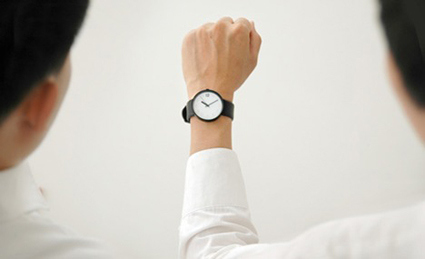
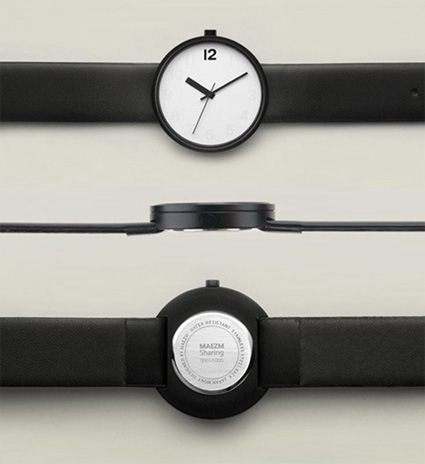
It is the tiniest of gestures in watch design – but it’s one that I’m loving. As a young kid without a watch I often had to steal glances off other people’s wrists to determine the time, and I’ve always appreciated people wearing watches with very legible faces. The “Sharing Watch” by Korean design studio maezm takes the concept a little further:
When someone asks what time is it, the wearer simply has to raise his arm: the watch face is rotated clockwise 90degrees, making it easier for both parties to read the time.

And it’s all achieved by simply (though really, this is probably the difficult part requiring very sensitive observation) discovering and communicating this very natural habit; and the rest of the design was probably straightforward with no modifications (minus the watch face orientation).
Clever!
Canal+ Ad
I think anything I say would probably give away the punch line – so: quite the fantastic ad from Canal+.
Comments (2)